Archive for the 'Space' Category
(Chronologically Listed)
Photos of distant worlds
[Thanks to Ace of Spades for the link!]
Over the past decade or so, astronomers have discovered over 300 extra-solar planets, that is, planets orbiting stars other than our Sun. However, these discoveries have largely been indirect, due to the planet transiting the star it orbits, or variations in the radial velocity of the star.
But now we have honest-to-goodness photographs of planets orbiting other stars.
The first here is the planet Fomalhaut b, orbiting the star Fomalhaut:
Fomalhaut itself has been blocked out in order for the telescope to take this photograph. The rays spreading out from the star are a processing artifact, but the planet is real, as is the dust ring.
Here’s the second planetary system, HR 8799:

The dots labeled ‘b’ and ‘c’ are two planets orbiting the star. Just too cool for words. Hat tip to Slashdot. ..bruce w..
DARPA Guts Falcon Blackswift

Earlier this year I outlined a DARPA project to produce a hypersonic UAV under the project name “Falcon Blackswift”
According to the few details available on Blackswift, Lockheed Martin’s famed Skunk Works shop is the main contractor for the vehicle. DARPA, in fact, still isn’t talking about Blackswift; it’s using the HTV-3X designation. But HTV-3X is a departure from the previous Falcon program. Careful observers at last week’s DARPATech, like Bill Sweetman, noticed some important elements: “Key features - apparent from images snagged from DARPA video, and from other sources - include the fact that HTV-3X is an unmanned, fighter-sized aircraft.”
Now word comes via Defense Tech Blog:
The Blackswift reusable hypersonic testbed has been canceled by the U.S. Defense Advanced Research Projects Agency (DARPA) after Congress slashed the program’s fiscal 2009 budget to $10 million, from $120 million.
“Congress made significant reductions in the amount of funds available to DARPA and the Air Force for the Blackswift testbed,” the agency said in a statement. “Based on this, DARPA determined that it would not be possible to proceed with the solicitation for the effort.”
Sadly this is probably just the first of many such cutting edge projects that will be eliminated as the federal welfare program for America’s largest banks consumes every dollar that could be going to improve our future technological edge.
Don’t Panic - NASA’s Tuesday Solar Press Conference

Friday the blog world was examining this curious press release from NASA:
NASA To Discuss Conditions On And Surrounding The Sun
WASHINGTON — NASA will hold a media teleconference Tuesday, Sept. 23, at 12:30 p.m. EDT, to discuss data from the joint NASA and European Space Agency Ulysses mission that reveals the sun’s solar wind is at a 50-year low. The sun’s current state could result in changing conditions in the solar system.
Bloggers took this in ran in several directions at once, ranging from NASA getting ready to declare that the next ice age is upon us, the Sun is about to go out and all manner of speculation in between. Now, courtesy of Watt’s Up With That, a bit of perspective.
The press conference Tuesday is instead to discuss this paper: Weaker solar wind from the polar coronal holes and the whole Sun
Abstract
Observations of solar wind from both large polar coronal holes (PCHs) during Ulysses’ third orbit showed that the fast solar wind was slightly slower, significantly less dense, cooler, and had less mass and momentum flux than during the previous solar minimum (first) orbit. In addition, while much more variable, measurements in the slower, in-ecliptic wind match quantitatively with Ulysses and show essentially identical trends. Thus, these combined observations indicate significant, long-term variations in solar wind output from the entire Sun. The significant, long-term trend to lower dynamic pressures means that the heliosphere has been shrinking and the heliopause must be moving inward toward the Voyager spacecraft. In addition, our observations suggest a significant and global reduction in the mass and energy fed in below the sonic point in the corona. The lower supply of mass and energy may result naturally from a reduction of open magnetic flux during this period.Received 11 June 2008; accepted 14 August 2008; published 18 September 2008.

What does this mean? The spacecraft Ulysses, which recently ended its mission, gathered a great deal of data about our Sun during its years orbiting pole to pole. Part of what it saw on its last orbit was a marked decrease in solar output. This is consistent with the “quiet sun” period we have been seeing the last several months.
Does this mean we should all run out and buy “Snow Machines”? It does mean that as long as these conditions hold, the Sun is pumping less heat and energy into Earth’s atmosphere. However keep in mind that our world’s oceans are an enormous heat sink, and any changes to input energy will only slowly make a difference in temperature over time.
The net outcome is the Ulysses project was a huge scientific win, and NASA would do well to consider a follow on mission in the same vein. If the trend continues, we have a fantastic opportunity to study our sun during a period of quiet unlike what we have had the opportunity to study in the modern age.
[Update] The awesome solar site solarcycle24.com shows a new “sunspeck” in today’s update. One of the tiny tiny little dots that have been the best that cycle 24 could muster thus far have shown up in the past hours. Sadly it’s too late for me to image it directly from the back porch…
Just in case you were wondering…
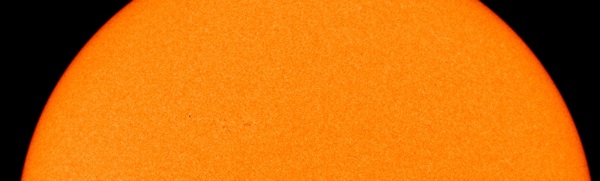
…the sun is blank — no sunspots:

This is how the sun has been for the last six weeks or so. ..bruce w..
Real Scientists Speak Up On… Global Cooling?

Get your snowboards waxed… the next ice age may be here soon!
I have been talking about how quiet sunspot cycle 24 has been, and how it’s possible that may foretell a cooler period in the Earth’s climate for the next set of years. I have also pointed out that I am a computer engineer, and come by these ideas based on personal study and application of new software techniques to assemble trends from huge quantities of information. That means take what I say with a grain of salt.
Now we get word from the excellent Watts Up With That site, stating that some of the real atmospheric scientists are starting to discuss the possibility of a much cooler world in a few years:
Four scientists, four scenarios, four more or less similar conclusions without actually saying it outright — the global warming trend is done, and a cooling trend is about to kick in. The implication: Future energy price response is likely to be significant.
Late last month, some leading climatologists and meteorologists met in New York at the Energy Business Watch Climate and Hurricane Forum. The theme of the forum strongly suggested that a period of global cooling is about emerge, though possible concerns for a political backlash kept it from being spelled out.
Words like “highly possible,” “likely” or “reasonably convincing” about what may soon occur were used frequently. Then there were other words like “mass pattern shift” and “wholesale change in anomalies” and “changes in global circulation.”
Noted presenters, such as William Gray, Harry van Loon, Rol Madden and Dave Melita, signaled in the strongest terms that huge climate changes are afoot. Each weather guru, from a different angle, suggested that global warming is part of a cycle that is nearing an end. All agreed the earth is in a warm cycle right now, and has been for a while, but that is about to change significantly.
The take away is that there are multiple atmospheric and solar factors pointing towards cooler temperatures for some period of time starting around the end of the decade. This could spell some serious trouble for scientists and weather networks who have staked their reputation on human boosted global warming.
In addition this interesting tidbit I stumbled across earlier today.. (Hey, I gave blood - I am allowed to be a bit stumbly!)

This is from NASA and is a long range forecast for sunspot cycle 25. Now these same goofs have been completely wrong on cycle 24 (the current cycle) with it clocking in well below their predictions. These graphs keep getting revised to push the cycle 24 bulge further right as the sun stays surprisingly quiet.
But if there is any accuracy in this, we could be looking at a marked decrease in solar energy reaching the earth for the next decade or two. For those of you wondering, that solar energy is the primary force that drives everything on earth, and is the only real mechanism to warm and heat the planet.
This will be interesting to monitor, but if you love snow sports (like I do) we may be headed into a golden age.
Sunspot Update - Our Quiet Sun

Our sun, the largest single input of energy to our world, continues its quiet period. For the past 16 days there has not been any sunspots on the face of our local star. If you discount the small spots visible only because of our modern powerful tools, the blank period is much longer than that.
As we noted earlier, the original estimates for solar cycle 24, which should have started months ago, was for it to be a nasty high-output affair. An active sunspot cycle that would boost the output of the sun, bathing the earth in excess light and heat, keeping the temperatures on the incline.
What this implies is anyone’s guess. But there are several theories about the last time the sun took a rest that coincided with significant cooling events, including a period known as the “Little Ice Age“.
The last period of minimum sunspot activity was in 1997. As you can see from the chart below (based on data from the excellent site solarcycle24.com), the current minimum started out in June 2007 in the normal range, but over the past few months have dropped off to a very quiet state.

If this continues, we will have a fantastic opportunity to study what happens when the sun goes quiet, and it will greatly enhance our understanding of how stars work. On the other hand, if it’s connected to periods like the little ice age, we may soon be looking for ways to emit as much CO2 as we can.
On Mars: Phoenix Lander Photographed In Descent

Over the long US holiday weekend, the latest Mars probe known as “Phoenix” landed near the Martian north pole. As wonderful as it is when we can actually get some of our gear on Mars to work correctly, it was even more fun that we were able to snap a picture of it taking place.
From space.com: Phoenix Lander’s Memorial Day on Mars
It was during Phoenix’s seven-minute plunge through the Martian atmosphere that NASA’s Mars Reconnaissance Orbiter caught this view of the lander dangling from its precious parachute. It is the first-ever view of a spacecraft landing on another planetary body.
The 30-foot (10-meter) wide parachute is the white object on the right, with its connecting chords running to the Phoenix lander’s back shell to the lower left. The parachute appears to be fully deployed.
“This is an engineer’s delight,” Phoenix project manager Barry Goldstein said in a mission update today at NASA’s Jet Propulsion Laboratory in Pasadena, Calif. “When this was first proposed, I was very skeptical.”
MRO caught this view of Phoenix from an altitude of about 472 miles (760 km) using its High Resolution Imaging Science Experiment (HiRISE) camera.The HiRISE recorded this image on May 25, 2008, at 4:36 p.m. Pacific Time (7:36 p.m. Eastern Time), NASA officials said. It is a highly oblique view of the Martian surface, 26 degrees above the horizon, or 64 degrees from the normal straight-down imaging of Mars Reconnaissance Orbiter, and has a scale of 0.76 meters per pixel, they added.
What is fun about the HiRISE camera is that it has high enough resolution and accurate enough positioning that they could catch this shot. It also shows how dead on everyone’s math was both for the Phoenix’s landing, and the MRO camera team. Given the speed that Phoenix was traveling, it was probably in the field of view for less than a couple of seconds, yet HiRISE was able to image it, seemingly without too much trouble.
I am looking forward to what kind of discoveries Phoenix is able to make near the Martian north pole. After the time and expense of sending the probe there, we are all hoping it landed some place interesting.

[Update - BRH] Seems it is in fact someplace interesting. Above is a picture of the Martian soil near the lander’s footpads. Notice the raised shape which scientists suggest comes sub-surface ice freezing and thawing to heave the soil into these shapes. Not only did the lander make it down safely, but it has deployed it’s solar cells, phoned home, set up its weather station and deployed the stereo camera. A busy little robot to be certain. Well done to JPL and everyone involved.
[Update - BRH] Another photo (below) of the Martian polar terrain from over at Bad Astronomy (excellent site for space nerdity!) showing the ground deformation possibly from subsurface water freezing and thawing.

Compare to this picture of similar deformation in the permafrost of Siberia.

NY Times silently corrects major scientific gaffe in story [UPDATED]
[UPDATE (05/26/08): See end of post for the response from the New York Times. Also note that there is now a correction note in place at the end of the article. On the other hand, I haven't been able to find any news about Fournier actually making the jump yesterday.]
This morning (Saturday, 5/24), the New York Times published a story by Matt Higgins about Michael Fournier’s planned attempt at a 25-mile parachute jump tomorrow (Sunday, 5/25). As originally published, the story contained this major scientific error (emphasis mine):
He intends to climb into the pressurized gondola of the 650-foot balloon, which resembles a giant jellyfish, and make a two-hour journey to 130,000 feet. At that altitude, almost 25 miles up, Fournier will see both the blackness of space and the curvature of the earth. He will experience weightlessness.
Then he plans to step out of the capsule, wearing only a special space suit and a parachute, and plunge down in a mere 15 minutes.
Of course, Fournier will not experience weightlessness in his capsule; instead, he’ll experience about 99% of his regular weight. If he were in fact weightless, then he wouldn’t fall when he stepped out of his capsule. I captured a screen shot of the article; you can pull it up here.
This evening, I checked again and — as I suspected might happen — found that the article had been silently corrected (with no notice of the original error) to now read as follows:
He intends to climb into the pressurized gondola of the 650-foot balloon, which resembles a giant jellyfish, and make a two-hour journey to 130,000 feet. At that altitude, almost 25 miles up, Fournier will see both the blackness of space and the curvature of the earth.
Then he plans to step out of the capsule, wearing only a special space suit and a parachute, and plunge in a mere 15 minutes, experiencing weightlessness along the way.
I read through the entire article and could find no acknowledgment of the original error. Here’s a screenshot of the corrected passage and here’s a screenshot of the end of the corrected article (showing no indication of the earlier error).
[UPDATE: 05/26/08]
I sent a link of this post to Craig Silverman at Regret the Error as well as directly to the NY Times Public Editor. Craig also wrote to the NY Times Public Editor, which seems to have gotten more response than my own e-mail. Here’s the personal response I got from Greg Brock, Senior Editor at the NY Times:
Craig Silverman passed along your posting about our change in the Sports article today. After we heard from about three dozen readers, we reached the reporter as soon as we could. Then a Sports editor I had talked to updated the article online — as has been our policy for sometime now.
Unfortunately, the editor forgot to give the Web editors an italic line to put at the bottom of the article acknowledging that it had been corrected. We have been using these italic lines rather than waiting for a print correction to run and then belatedly appending it to the online article. That sometimes takes days. (Certainly on a long holiday weekend.) In this case, alas, one of our human beings actually screwed up. Imagine that? If only we could make everything automated we wouldn’t have to be running around in circles on things like this. (Of course, we wouldn’t have a job that kept us running in circles either.)
We have had a long-standing policy at The Times of acknowleding our errors and correcting them. After all, we publish almost 4,000 corrections a year. This policy, of course, also applies to articles online — whether the article was originally in the print editions or was written just for the Web site.
Anytime you see something like this and are puzzled, feel free to drop me a line and ask. Readers ask us about these things all the time; we are always grateful when they call it to our attention. There’s usually a simple explanation for it . We really aren’t as conspiratorial and sinister as some folks think We just screw up. And boy are we good at it.
Best regards,
Greg Brock
Senior Editor
Still Waiting For Sunspots

A quick check of space weather shows us that once again the face of the sun is blank - no sunspots. In the past few weeks we have had a few tiny sunspots show up that are part of the last sunspot cycle, but it seems we are still waiting for cycle 24 (the new cycle) to start up.
Now from the Arizona Daily Star’s astronomy section, this bit of news:
Many solar scientists expected the new sunspot cycle to be a whopper, a prolonged solar tantrum that could fry satellites and raise hell with earthly communications, the power grid and modern electronics. But there’s scant proof Sunspot Cycle 24 is even here, let alone the debut of big trouble. So far there have been just a couple minor zits on the face of the sun to suggest the old cycle is over and the new one is coming.
The roughly 11-year cycle of sunspot activity should have bottomed out last year, the end of Cycle 23 and the beginning of Cycle 24. That would have put the peak in new sunspot activity around 2012.
But a dud sunspot cycle would not necessarily make it a boring period, especially for two solar scientists with the Tucson-based National Solar Observatory.Two years ago, William Livingston and Matt Penn wrote a paper for the journal Science predicting that this could not only be a dud sunspot cycle, but the start of another extended down period in solar activity. It was based on their analysis of weakening sunspot intensity and said sunspots might vanish by 2015.
And here’s the punch line: That last long-term down period, 1645-1715, coincided with the Little Ice Age, a period of bitter cold winters. That kind of talk could ruffle some feathers in this time of climate change and global warming, starring man-made carbon dioxide as the devil. The paper, rejected in peer review, was never published by Science. Livingston said he’s OK with the rejection.
To sum up - our sun is not operating on the “consensus” plan. In fact the consensus (as I reported earlier) was that cycle 24 would be the strongest one we have seen in quite a while. Instead we are off to a very weak start. Furthermore a scientist team who went against the consensus orthodoxy and tried to publish their work were shut down because they flew in the face of what everyone accepted.
I would like to point out that things like plate tectonics (the foundation of modern geology), the cause of stomach ulcers being bacteria, the notion that the earth orbited the sun, and a host of others all went against the “consensus view” and went on to change the way we understand nature.
There is a very real possibility that our local star is heading into a quiet period that will see greatly reduced solar output. Net result could be a prolonged cold period, just at the time when we are trying to mobilize humanity to fight an anticipated warming trend. As published at the Goddard Space Flight Center:
A new NASA computer climate model reinforces the long-standing theory that low solar activity could have changed the atmospheric circulation in the Northern Hemisphere from the 1400s to the 1700s and triggered a “Little Ice Age” in several regions including North America and Europe. Changes in the sun’s energy was one of the biggest factors influencing climate change during this period, but have since been superceded by greenhouse gases due to the industrial revolution.
They determined that a dimmer Sun reduced the model’s westerly winds, cooling the continents during wintertime. Shindell’s model shows large regional climate changes, unlike other climate models that show relatively small temperature changes on an overall global scale. Other models did not assess regional changes.
[Update] For a fantastic write up for an actual scientist (instead of an eccentric crackpot like me) go read “Sunspot cycle more dud than radiation flood” at the excellent Watts Up With That?
USA 193 Shoot Down Video
The US Navy and the Ballistic Missile Defense Organization have compiled a nice collection of video from this past winter’s shoot down of a broken NRO satellite known as USA 193. It includes footage aboard USS Lake Erie (the cruiser who took the shot) as well as cameras that show the moment of impact with simulation footage of the SM-3 missile in flight. Quite a nice summary.
Hit tip to Wired’s Danger Room