"And still I persist in wondering whether folly must always be our nemesis." -- Edgar Pangborn

    The authors

    Bruce Henderson is a former Marine who focuses custom data mining and visualization technologies on the economy and other disasters.

    Bruce F. Webster has been trying to make IT work since 1974. He hasn't given up yet.

    Admin


Archive for the 'Mashups' Category

(Chronologically Listed)

    09 Dec

    Selecting The Best Bus For London

    top_gear_bus_race2.jpg

    Having spent a bit of time in the UK, I can attest that in general the programming on television is just as mindless and annoying as the US has on average.

    But like the US, there are some patches of real brilliance. For example the below clip from the car focused show “Top Gear” where the crew work hard to help the City of London determine which is the best bus… by racing them.

    02 Dec

    Lost At Sea - Inflatable Breasts

    There are some events that just defy the mashup engine:

    Men’s magazine loses 130,000 inflatable breasts

    A men’s magazine has lost a shipment of 130,000 inflatable breasts en route to Australia. The breasts, worth £100,000, were planned to be a free gift in Ralph magazine - but vanished before arriving at their destination. A spokeswoman said the container left docks in Beijing two weeks ago but turned up empty in Sydney this week.

    The magazine has put out an alert to shipping authorities but the breasts need to turn up in the next 48 hours to make the January issue. Ralph editor Santi Pintado urged anyone with information to contact the magazine, saying: “Unless Somali pirates have stolen them it’s difficult to explain where they are.

    “If anyone finds any washed up on a beach, please let us know. We want our boobs back.”

    The Maritime Safety Authority said it had no information on any lost consignment.

    27 Nov

    America Gets Rickrolled!

    In case you don’t know, there is a trend on the internet known as Rickrolling:

    Rickrolling is an Internet meme typically involving the music video for the 1987 Rick Astley song “Never Gonna Give You Up”. The meme is a bait and switch: a person provides a Web link they claim is relevant to the topic at hand, but the link actually takes the user to the Astley video.

    When a person clicks on the link given and is led to the web page he/she is said to have been “Rickrolled” (also spelled Rickroll’d). By extension, it can also mean playing the song loudly in public in order to be disruptive

    So there I was, watching the Macy’s parade. The dopey Cartoon Network float is rolling by, and in the midst of whatever song they were doing, the whole things stops and out pops Rick Astley. I have not laughed that hard in at least a year.

    27 May

    The FDIC Mystery - What Happened To Q1 2008?

    fdic_logo.png

    Some folks may have noticed that we have yet to update our trend animator with banking data for the first quarter of 2008. It’s not because we don’t want to, it’s because the FDIC has yet to release their data.

    Yes, that’s right - one of the more interesting quarters of the US banking industry since the start of the Great Depression, and the FDIC is still trying to compile the data. I don’t think they are trying to hide reality from us, rather there may be some problems getting the biggest banks to cough up the information required by law.

    Some things I am really looking forward to shining our floodlight on
    • Increase in non-performing loans
    • Level of 90+ day late mortgages they are holding
    • Changes to how much money they are getting from the discount window and other more exotic funding sources from the US Federal Reserve

    We will have this all in graphical glory the moment we can get our hands on it.

    23 May

    Trend Animator - Now Open Source

    Trend Animator May 08.png

    Many folks were very keen on the animated charts we created for the FDIC data on the looming banking problems. The charts are quite similar to the groundbanking work of gapminder.org, which was purchased by Google some time ago, with the promise that their wonderful charting tools would be available “soon”.

    Since then, we have decided we are going to make the chart code (in flash) open-source. The project is here by available on Source Forge as OSG Trend Animator

    Feel free to download the code, experiment with it and do good things.

    Salute to Nathan Redding who did the coding for this great component.

    08 Apr

    CO2 Mashup - Largely Hot Air

    Vulcan_Low.jpg
    Click on image for greater detail

    Word via io9 that Purdue has put together a map of the US showing their guess of CO2 emission density.

    They call the System “Vulcan” and it’s interesting because there is no sensor grid for CO2. Instead Vulcan derives a guess on CO2 density from local air pollution data from the EPA sensor grid. (here as well)

    To create the Vulcan maps, the research team developed a method to extract the CO2 information by transforming data on local air pollution, such as carbon monoxide and nitrous oxide emissions, which are tracked by the Environmental Protection Agency, the U.S. Department of Energy and other governmental agencies.

    While it’s fun that they are trying to show this data, the science behind it is (in my opinion) quite flawed. First off, they do not have the means of directly measuring CO2, so they take a guess based on other air pollutants. One thing that drives me insane is opaque scientific data. If you are confident in your approach, share the source data and let us “trust but verify”. Who knows how they cooked up their guess?

    A preliminary analysis of the Vulcan data suggests that previous maps of U.S. fossil fuel emissions were inadequate for current scientific and policy-making needs, Gurney says.

    “When you compare the old inventories to Vulcan, the new data show atmospheric CO2 differences that are as large as five parts per million in some U.S. regions in the late winter,” he says. “The levels in the global atmosphere only rise one and a half part per million every year, so this is the equivalent of three years of global emissions in the atmosphere that isn’t where we thought it was. This will be important for policy-makers and is enormous from a scientific point of view. It’s shocking.”

    Anyone surprised that they are finding data that shows things are more severe than they thought? Give me a break people, how about some scientific honesty here?

    Gurney is Kevin Gurney of the Purdue Climate Change Research Center (PCCRC). He is also the author of “Mending the Ozone Hole“, which was another big scare in the 90’s that caused massive misallocation of capital for something that turned out not to be a real problem after all.

    I am surprised not to see massive CO2 “red spot” in eastern central California; an area of heavy volcanic emission of CO2, Carbon Monoxide and other “green house gasses”. This omission alone calls the accuracy of this visualization into question.

    Professor Gurney - how about CO2 uptake as well? Did you take vegetation into account in your models? The sad truth is we just don’t know do we? We get the “cooked” data and have to trust someone who clearly is pushing an agenda. Advocacy journalism is bad, advocacy science is much worse (almost as bad as advocacy intelligence).

    If I could wish for something here, it would be for the Global Warming shills on the take from “Big Green” would be more transparent in their sources and methods, and allow everyone who is skeptical to either convince themselves or point out the flaws.

    A system such as Vulcan will be an important tool to understanding our lack of understanding of emissions and what impact (if any) they have on the environment. But it will require transparent methods for data collection, aggregation and display to be credible in what has become a politically driven, agenda subscribing sector of atmospheric science.

    12 Mar

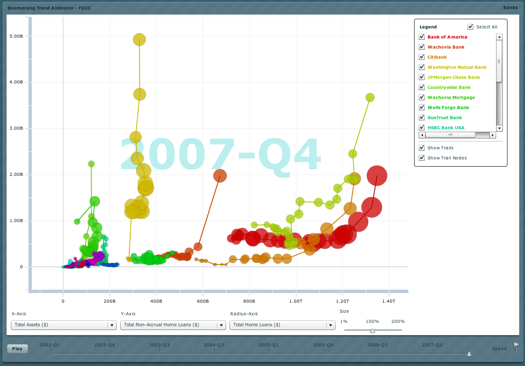
    Charting The Banking Crisis - A Boomerang Demo

    Money Burning In The Fires Of Deflation

    Anyone who has been following the financial news knows that banks and other large financial institutions are under a growing amount of strain given the misguided investments in speculative ventures over the past 5 years, including mortgages and exotic credit / investment packages.

    While chasing down what state a company like Merrill-Lynch might be tough, banks are required to report data to the FDIC. The bad news is you end up with a massive pile of tabular text data that makes for potent nap fuel. Readers will recall that my team has been working on new techniques for finding and presenting massive information sets, a technology based on mashups and the semantic web we call Boomerang.

    We decided to apply the Boomerang approach to this mass of data, adding in some ideas from the groundbreaking gapmider.org effort to create a dynamic overview of just how tough it’s getting for banks and their mortgage portfolios.

    Charts and data after the jump.
    (more…)

    16 Feb

    Housing Price Trends - Phoenix Metro Area

    Today we use data from Hardtack to take a closer look at the market in Phoenix. The Phoenix metro area saw explosive growth during the housing bubble, including developments and communities built where they honestly did not make any sense. In addition many of the properties were snapped up by California “Equity Locusts” looking to flip hot properties in the Phoenix sun for a huge windfall. As a result of these factors the Phoenix market is somewhat unique. There are large sections of suburbs that are for sale, some by owners upside down in their mortgages competing with banks who are selling their foreclosures.

    As a reminder about the data, all real estate sales are governed by the local real estate board, who own and control a specialized database system called the MLS, or multiple listing service. By monitoring the data flowing through these MLS systems, we are able to see what sellers are hoping to get for their property, and measure several parameters about the property for sale.

    So just keep in mind, these are prices that the sellers are hoping to get, as listed out in the MLS database for the various areas around and in Sacramento.

    Below is a chart showing the major cities of the Phoenix MSA, and how the price per square foot has changed over the past year (click on the chart for a larger view).

    Phoenix-Majors-sm.png

    Of interest here is just how sideways the overall market seems. Some of this is because Scottsdale is skewing the numbers on the chart. Full breakdown by region after the jump.

    (more…)

    14 Feb

    Housing Price Trends - Sacramento County Detail

    Once again it is time to turn loose a new set of statistics on a segment of our nation’s housing market courtesy of Hardtack. Hardtack now has been collecting data for about a year, and some trends are clearly identifiable in the data.

    Last time we were looking at details of the declines (and some increases) in San Diego county. Today we are looking at the Sacramento area, which is giving San Diego a run for it’s money when it comes to declines in the housing market. If you want to check out the specific statistics for Sacramento as they happen, feel free to visit the Sacramento page over on the Hardtack site.

    As a reminder about the data, all real estate sales are governed by the local real estate board, who own and control a specialized database system called the MLS, or multiple listing service. By monitoring the data flowing through these MLS systems, we are able to see what sellers are hoping to get for their property, and measure several parameters about the property for sale.

    So just keep in mind, these are prices that the sellers are hoping to get, as listed out in the MLS database for the various areas around and in Sacramento.

    Below is a chart showing the major cities of the Sacramento MSA, and how the price per square foot has changed over the past year (click on the chart for a larger view).

    Sacramento_Majors_Sm.png

    Full details with lots of charts after the jump

    (more…)

    12 Feb

    Sacramento Housing Prices Declines - Preview

    I am on the road for the beginning of this week, but I wanted to post some overview graphs of what is happening in the Sacramento housing market. As you can see there is quite a drop in the asking price per square foot listed in the MLS.

    Sacramento_Majors_sm.png

    You can click the chart above for a larger view. The cities were chosen from the full data set for Sacramento, which I will work to have posted before the end of the week. As you can see the community of Sacramento itself is taking a huge hit, down 24% in asking price from a year ago, along with the bubble town of Elk Grove which has been featured in the news as a center of foreclosures.

    These prices are the average cost per square foot as listed in the MLS databases for the communities in the Sacramento area. All data was gathered by the Hardtack mashup project that we have been running for past year.

    City Name List Price Change
    Walnut Grove, CA -33%
    Elk Grove, CA -24%
    Sacramento, CA -24%
    Rancho Cordova, CA -21%
    West Sacramento, CA -20%
    Rio Linda, CA -18%
    Roseville, CA -15%
    El Dorado, CA -11%
    Auburn, CA -10%
    Davis, CA -3%
    Colfax, CA -1%

    A big thanks to Sacramento Land(ing) for being a significant traffic generator for Hardtack, we appreciate it!


  • Buy Viagra
  • Buy Cialis
  • Buy Tramadol
  • Buy Accutane
  • Buy Propecia
  • Order Propecia
  • Buy Viagra Online
  • Buy Soma
  • Buy Tramadol
  • Buy Cialis
  • Buy Cialis
  • Buy Viagra
  • Order Viagra
  • Order Cialis
  • Buy Ultram
  • Buy Viagra
  • Buy Cialis
  • Buy Tramadol
  • Buy Viagra
  • Buy Cialis
  • Buy Tramadol
  • Buy Accutane
  • Buy Viagra
  • Buy Cialis
  • Buy Levitra
  • Buy Tramadol
  • Buy Soma
  • Buy Propecia
  • Buy Ultram
  • Buy Accutane
  • Buy VPXL
  • Buy Xenical