Archive for the 'History' Category
(Chronologically Listed)
Nuclear criticality accidents over the past 60+ years
I’m trying to figure out where I ran across the link for this report (PDF, 3.7 MB); it was sometime in the past few weeks and was most likely from one of the science blogs I review daily, but I just can’t remember where.
The report (”A Review of Criticality Accidents”) details sixty (60) criticality accidents, that is, accidents where radioactive material that was being processed achieve critical mass sufficient to discharge a burst of radiation. These date from 1945 to 1999 and include America, Soviet/Russian, Japanese and British incidents.
The earliest is one of the most famous. It occurred at Los Alamos on August 21, 1945. From the report:

In the first accident, a critical assembly was being created by hand stacking 4.4 kg tungsten carbide bricks around the plutonium core. Figure 41 shows a reenactment* of the configuration with about half of the tungsten blocks in place. The lone experimenter [Harry Daghlian] was moving the final brick over the assembly for a total reflector of 236 kg when he noticed from the nearby neutron counters that the addition of this brick would make the assembly supercritical. As he withdrew his hand, the brick slipped and fell onto the center of the assembly, adding sufficient reflection to make the system superprompt critical. A power excursion occurred. He quickly pushed off the final brick and proceeded to unstack the assembly. His dose was estimated as 510 rem from a yield of 1016 fissions. He died 28 days later.
An almost-identical accident involving the exact same plutonium core occurred at Los Alamos the following year, exposing several people. The person working with the plutonium core, Louis Slotin, died nine days later. And, as I’ve just discovered, I have a family connection to that core, which became known as the “Demon core“. It was used in the Able bomb in the Crossroads (Bikini Atoll) nuclear tests — where my father, all of 22 years old, was one of the sailors who went on board the target ships after the blasts (Able and Baker) to survey damage.
Here’s another criticality accident, this one in Russia in 1958:
After each experiment was completed, written procedures called for the solution to be drained through a line to favorable geometry 6 liter bottles. This process was to be repeated until the entire experiment vessel had been drained. After filling some of these 6 liter bottles, the experimenters judged the remaining solution volume to be highly subcritical. It was then decided to circumvent the routine, tedious draining process and manually pour the remaining solution of 418 g U(90)/ l from the vessel (there are no records of the molarity of the solution). To accomplish this, the neutron source and its guide tube were removed and then the vessel was unbolted from its stand. Then three of the experimenters manually lifted the vessel and began to move it (in order to directly pour the contents into containers) when the excursion occurred.
They immediately noticed a flash (due to Cherenkov radiation), and simultaneously, fissile solution was violently ejected, reaching the ceiling about 5 m above. The three experimenters dropped the vessel and, along with a fourth experimenter who was located about 2.5 m away from the excursion, went immediately to the change room, showered, and were transported to the hospital. The combination of additional reflection from the three experimenters and the change in the geometry of the solution volume was sufficient to cause the system to exceed prompt critical. The small neutron background, estimated at only 100 neutrons per second, apparently also contributed to delayed initiation and thus to increased excursion energetics.
Based on fission product activity in the solution, the single–pulse yield was evaluated to be approximately 2 × 10¹⁷ fissions. Total neutron and gamma absorbed doses were estimated at 6,000 ± 2,000 rad for the three who lifted the tank and 600 rad for the coworker at 2.5 m. The three massively exposed workers died in five to six days. The fourth experimenter survived but had acute radiation sickness, followed by continuing health problems. She developed cataracts and lost sight in both eyes some years later. Due to the severe consequences of this accident, the experimental apparatus was disassembled and the critical experiment program at the plant was terminated.
Something to keep in mind the next time you watch “The Simpsons”. ..bruce w..
Remembering Pearl Harbor
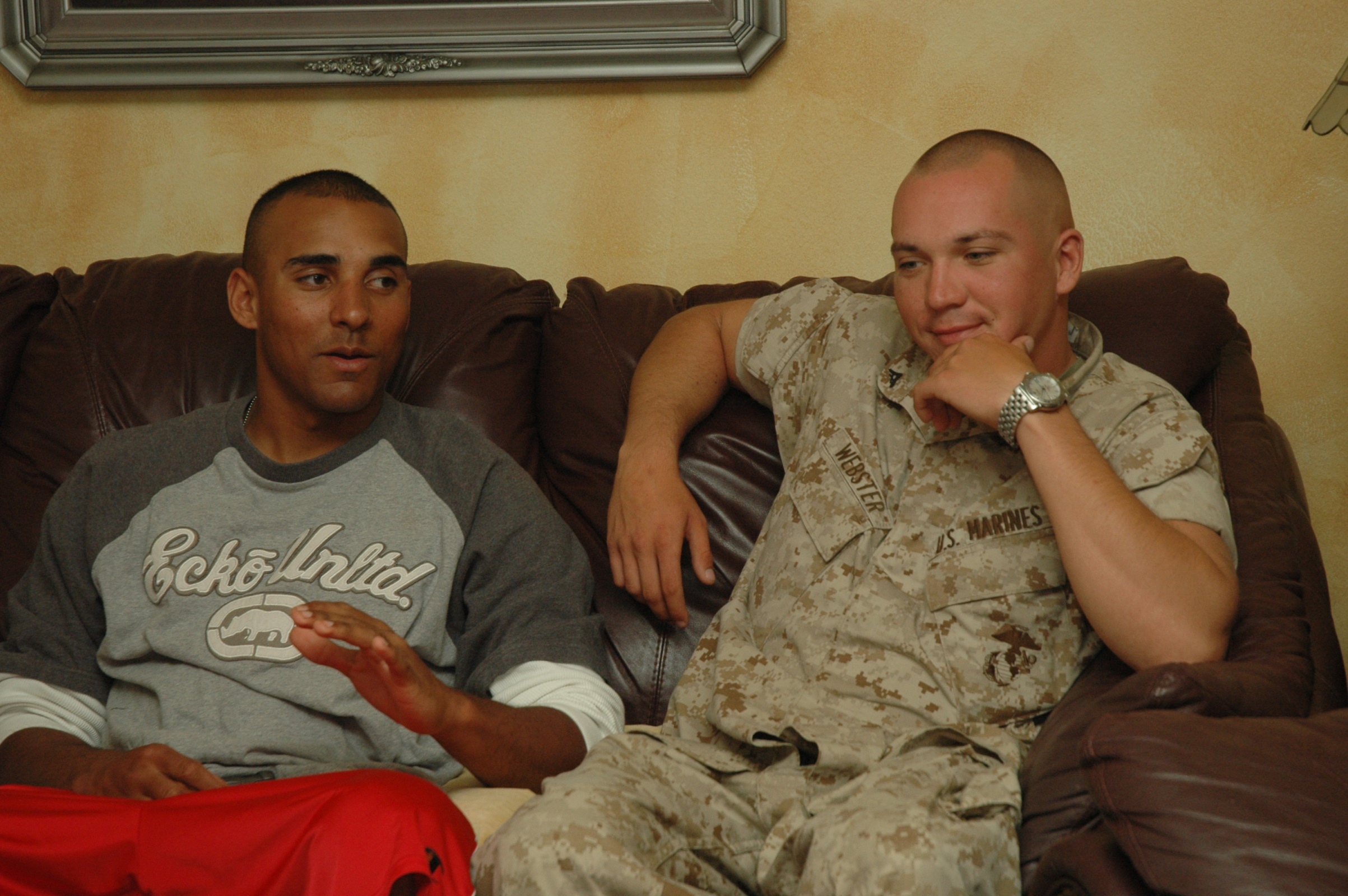
My dad, John A. Webster, was a seaman aboard the USS San Francisco (CA-38) at Pearl Harbor on December 7, 1941. Fortunately, the San Francisco was docked some distance from Battleship Row (look down to the lower right corner) and so was not subjected to the heavy bombing that damaged or sank so many other ships :

Dad said that the San Francisco’s guns had been dismantled for cleaning and repairs, and so the sailors on board were reduced to using rifles and sidearms to shoot at the Japanese planes.
It was my visit to the USS Arizona memorial in 1975 that led me to realize how many hundreds and hundreds of young men like my father died in those few hours — and how easily our own family could never have been.
Randy Barnett over at the Volokh Conspiracy has a wonderful and extensive remembrance of Pearl Harbor, including quite a few photos and video clips. ..bruce w..
233 Years of Semper Fi

MCRD Platoon 3010 - 1984 - click for full size.
November 10th is a special day for Marines, it’s the day we celebrate the birthday of our beloved Corps. The Marines are a tough, no-nonsense force focused always and forever on the mission.
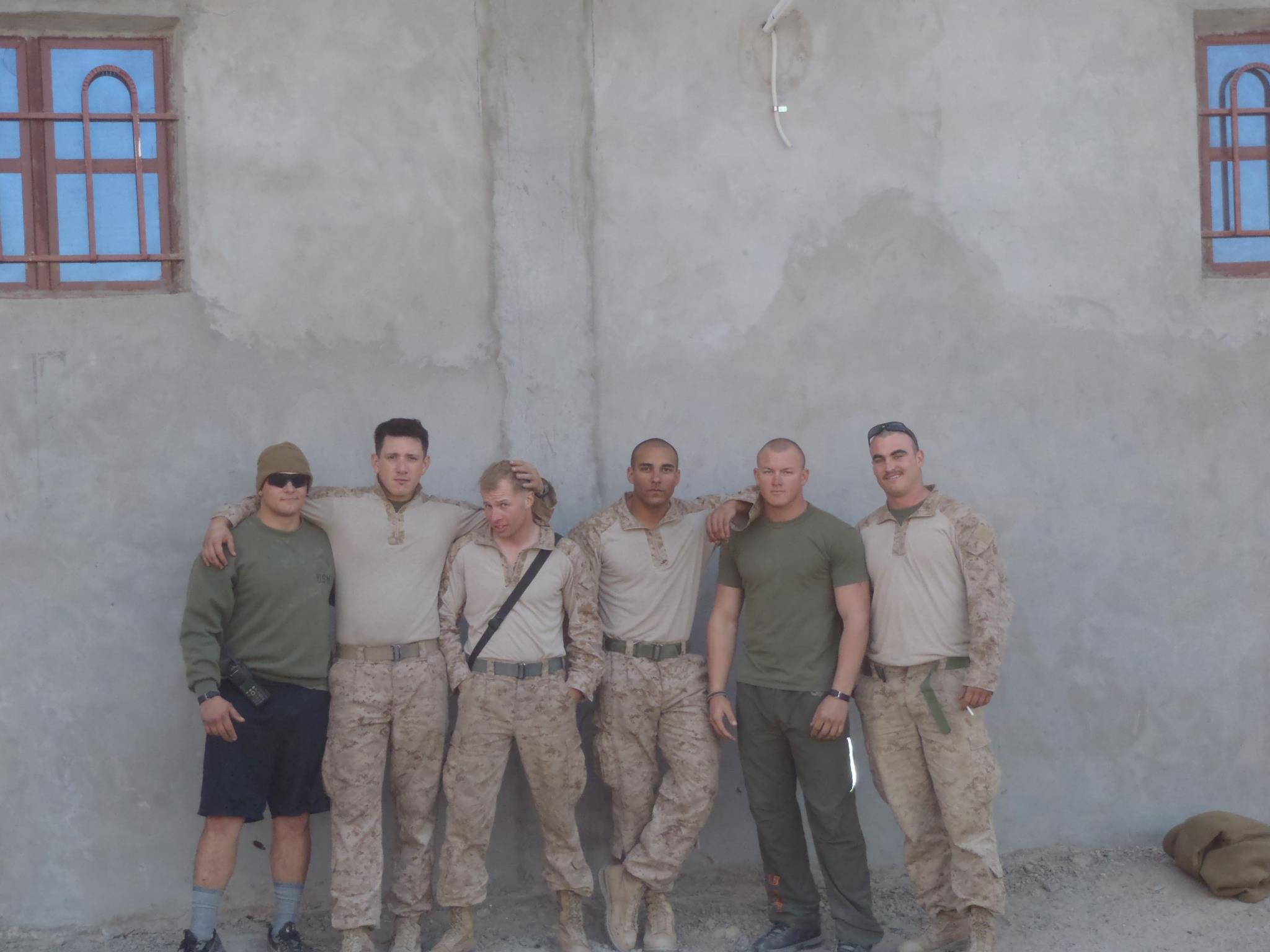
On this 233rd, I would like to give a salute to all the Marines I served with, including
Sean Church aka “HenderChurch”
Tim Maroe aka “Le Midget”
Jim Sanchez
Matt Keske aka “Poopsan”
John Winkleman
Jerry Bogen
Mark Corlew
Tim Peters
Matt Johnson
Staff Sergeant Oliver
Gunny Roleson
Pat Muritore
Michael Tan
Staff Sergeant Zorman
Staff Sergeant Figueroa
John Pollock
John Lear
Eric Covington
Rick Piva
Harry Roads
Smitty
Jade Chavis
Sam Bennet aka Sammy Love
and all the others that I can’t rattle out of my head right now. And a special salute to Phil Berry who talked me into signing up. One of the best decisions ever.

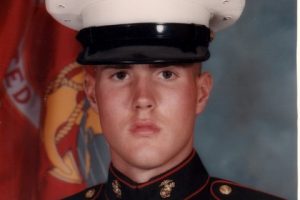
Bruce as a tiny jarhead, days before graduating boot camp in April of 1984.
Black Five has a nice write up as well…
Update - the Commandant has posted his birthday message on You Tube. The opening includes the orders to have Marines head to Lebanon. I vividly recall this event, which figured prominently in my decision to join.
Iowahawk Nails It
Iowahawk shows that brevity is the soul of wit:
So for now, let’s put politics aside and celebrate this historic milestone. In his famous speech at the Lincoln Memorial 45 years ago, Dr. King said “I have a dream that one day my children will live in a nation where they will not be judged by the color of their skin, but by the content of their character.”
Let us now take pride that Tuesday we Americans proved that neither thing matters anymore.
Caithness The Beautiful
For the past two days I have been in the far north of Scotland, in a county called Caithness. It is as far north as you can go on the island of Britain without a boat.
Caithness is the land of my Henderson ancestors, and in particular the area around a village called Dunbeath.
First and foremost, I have to thank the Dunbeath Heritage Centre and Preservation Trust, who run a fantastic museum in the village of Dunbeath. They have a robust collection of genealogy information for the families of that area, but that is just the start.
Dunbeath has been a center of civilization for at least a thousand years, and probably quite a bit longer. The Museum preserves this history, and serves as a focal point for the research and discussion around the continuing archeological finds. It seems the history of this area is still be discovered, and there are significant digs durning the summers, and local researchers such as George Bethune and Meg Sinclair are helping lead the efforts.
On the the photos….
First off, this is the Heritage Centre, which is housed in the old school house.

Dunbeath Harbor

Also there is a walking trail along the Dunbeath river, which features prominently in several books, such as Highland River, by Neil M. Gunn (who it turns out is a cousin).


The path winds up towards the headwaters of the river, and past many historical sites.
Dunbeath sits on the rugged Caithness coast, which seems to be naturally photogenic


Dunbeath is also flanked by the northern most mountains in Scotland, and thanks to the recent cold snap they are wreathed in snow. This one is named Scaraben

Last but not least for me, is a view from the old graveyard in Berriedale, where several of my ancestors are buried

For more / somewhat larger versions of these pictures, I have uploaded them to another area of the site, just click on the name to view.
Some words of wisdom for Sarah Palin
Plus ça change, plus c’est la meme chose:
“I am often made aware of the utter uselessness and folly of seeking to vindicate my character…from the simple fact that although foul aspersions can be bruited far and wide, held to the fluttering breeze by every press and rolled as sweet under every tongue, yet while the vile slander is fairly refuted and truth appears in the most incontestable manner it is permitted to lie quietly upon the shelf in slumber the sleep of death or if by chance it should get published in some obscure nook or corner of this great republic be most religiously suppressed as tho in fear that the truth should be known and believed.”
– Brigham Young writing to (then) U.S. Secretary of War Jefferson Davis, 1855 (quoted in 40 Ways to Look at Brigham Young, Orton & Slaughter, Deseret Book, 2008)
Doesn’t look as though the interwebs have changed things all that much. ..bruce w..
A Day That Lives In Infamy
Approach this day with caution, those who have vivid memories. This morning I turned on the news and was confronted with a “replay” of the September 11th, 2001’s news cast.
I can clearly remember being up early that morning for a teleconference with clients on the east coast of the US, and deciding to pass the time by watching a bit of news. At that time the first plane had just the World Trade Center, and my first thought was “what a tragic accident - how did that happen?”.
Minutes later, most of the US that was watching TV saw United Flight 175 pass into view at its full speed and strike the second tower, erupting in a massive fireball that blasted out of the north side of the building.
Seven years have passed with no follow up attack, and America has largely moved on, myself included. It is easy to think that “this could not happen again”. Many times there has been a media fright over the use of a dirty bomb, a suitcase nuke, a weapon smuggled in from abroad in a shipping container. How many of these were a reflection of our fears, and how many were quietly aborted by the people that protect our safety?
In the years that followed the attack, there was a constant worry that Al-Qaeda was working hard to top the September 11 attacks. No such attacks materialized. Was it because of increased security? A massive intelligence effort to foil any plans? Skillfully applied violence from the US military? We may never get to know. In fact Al-Qaeda has been greatly reduced due to direct action by the US Military and associates. Their credibility as a world leader in the Jihad against the decadent west has been diminished, as they have not mounted an effective large scale operation since the bombings in Madrid.
There is a popular movement to despise the war in Iraq and label it in a wide spectrum of highly exaggerated terms. History is likely to show that Iraq provided the angry, radical muslim young men who were filled with bravado by the September 11th attacks a ready means to martyr themselves for the cause of Jihad. Why Iraq mattered was that much closer to the source of Jihad martyrs (and farther from the US) and the targets shifted from the US civil population to the US Military. Thousands of uniformed Americans have lost their lives and tens of thousands of Iraqi citizens. But the net effect was to show first hand to the middle east the futility of the Jihad / suicide approach, and to send legions of young men bent on jihad on the fast path to hell. Once these young men had killed themselves for the cause, they were no longer available to do harm to anyone else.
It is my opinion that 50 years from now, the war in Iraq may well be considered a stroke of genius, as hard as it may be to consider today.
The lesson of September 11th is that we ignore the forces that threaten us at our own peril. In the years that have passed since then, huge efforts by the intelligence community have greatly enhanced our nation’s ability to find and track people planning harm on a large and small scale, against a backdrop of increasing anger from an American public who worries what happened to the liberty and freedom they used to enjoy.
As the memories of that day fade, we must make the effort to remember the terrible cost of complacency taught to us on a clear September morning. We must never forget.

Sunspot Update - Our Quiet Sun

Our sun, the largest single input of energy to our world, continues its quiet period. For the past 16 days there has not been any sunspots on the face of our local star. If you discount the small spots visible only because of our modern powerful tools, the blank period is much longer than that.
As we noted earlier, the original estimates for solar cycle 24, which should have started months ago, was for it to be a nasty high-output affair. An active sunspot cycle that would boost the output of the sun, bathing the earth in excess light and heat, keeping the temperatures on the incline.
What this implies is anyone’s guess. But there are several theories about the last time the sun took a rest that coincided with significant cooling events, including a period known as the “Little Ice Age“.
The last period of minimum sunspot activity was in 1997. As you can see from the chart below (based on data from the excellent site solarcycle24.com), the current minimum started out in June 2007 in the normal range, but over the past few months have dropped off to a very quiet state.

If this continues, we will have a fantastic opportunity to study what happens when the sun goes quiet, and it will greatly enhance our understanding of how stars work. On the other hand, if it’s connected to periods like the little ice age, we may soon be looking for ways to emit as much CO2 as we can.
C. S. Lewis on fascism and the singularity
I am a great fan of Jonah Goldberg’s book, Liberal Fascism, for its willingness to go back and actually look at the historical rise of fascism (and Fascism) in the 20th Century, in our own country (under Woodrow Wilson), in Italy (under Mussolini), in Germany (under Hitler), and in Russia (under Stalin). Indeed, I consider Liberal Fascism along with Amity Shlaes’ The Forgotten Man to be the two most important works of 20th Century US political history written in the past decade.
So it was with sensitized eyes that I found myself re-reading The Abolition of Man by C. S. Lewis, written in 1944 and addressing “Reflections on education with special reference to the teaching of English in the upper forms of schools” (the actual subtitle of the work). I happened to pick this up again due to a passing reference to this work over at Jerry Pournelle’s blog.
Those who think of Lewis merely as a ‘Christian apologist’ should take the time to read this book or, say, his lectures on Paradise Lost. He was a brilliant logician and at the same time profoundly humble — a most unusual combination. But he was never shy about quietly, methodically dismantling what he saw as shoddy or unfounded reasoning. You may disagree with his premises, but it’s much, much harder to pick apart the chain of logic that leads to his conclusions.
Lewis, as always, is eminently quotable, and so it’s hard to pick and choose. But since fascism has been on my mind, this paragraph — where he is talking about advances in science and knowledge, particularly in shaping human nature and even human form — leaped out at me:
For the power of Man to make himself what he pleases means, as we have seen, the power of some men to make other men what they please. In all ages, no doubt, nurture and instruction have, in some sense, attempted to exercise this power. But the situation to which we must look forward will be novel in two respects. In the first place, the power will be enormously increased. Hitherto the plans of educationalists have achieved very little of what they attempted and indeed, when we read them — how Plato would have every infant ‘a bastard nursed in a bureau’, and Elyot would have the boy see no men before the age of seven and, after that, no women, and how Locke wants children to have leaky shoes and no turn for poetry — we may well thank the beneficent obstinacy of real mothers, real nurses, and (above all) real children for preserving the human race in such sanity as it still possesses. But the man-moulders of the new age will be armed with the powers of an omnicompetent state and an irresistible scientific technique: we shall get at last a race of conditioners who really can cut out all posterity in what shape they please. (pp. 59-60)
We speculate much about the coming singularity, which Lewis himself appears to glimpse in this chapter. What we talk less about is what happens if the first humans to make a singularity transition have — out of all good intentions (go read Goldberg)! — fascist tendencies. The thought of a trans-human Woodrow Wilson — much less a Mussolini, Hitler, or Stalin — is a chilling thought indeed. ..bruce w..
UPDATE: I have to put in one more quote from Lewis:
I am not thinking here solely, perhaps not even chiefly, of those who are our public enemies at the moment [1944]. The process which, if not checked, will abolish Man goes on apace among Communists and Democrats no less than Fascists. The methods may (at first) differ in brutality. But many a mild-eyed scientist in pince-nez, many a popular dramatist, many an amateur philosopher in our midst, means in the long run just the same as the Nazi rules of Germany. Traditional values are to be ‘debunked’ and mankind to be cut out into some fresh shape at the will (which must, by hypothesis, be an arbitrary will) of some few lucky people in one lucky generation which has learned how to do it. The belief that we can invent ‘ideologies’ at pleasure, and the consequent treatment of mankind as mere hyle [Greek: matter, clay], specimens, preparations, begins to affect our very language. Once we killed bad men; now we liquidate unsocial elements. Virtue has become integration, and diligence dynamism, and boys likely to be worthy of a commission are ‘potential officer material’. Most wonderful of all, the virtues of thrift and temperance, and even of ordinary intelligences, are sales-resistance. (p. 74)
As always, ahead of his time. ..bfw..
Nerd History Lesson - Evil Bruce
A blast from the past, circa 1992. The place is San Diego, the company is Pages Software. Back then the internet was not yet invented, but we has usenet news groups.
The following appeared Jan 17, 1992 in comp.sys.next.misc
Just how many Bruce’s are there at Pages?
Well,
I have recently gotten a couple of peices of Mail from people assuming that I
am Mr. Bruce Webster, author of the NeXT Book. Just to set the record
straight, he is bwebster@pages.comI am bruce@pages.com (Bruce Henderson). (contains less than 1% of the USDA allowance of Webster)
So let’s summerize.
Bruce Webster:
Used to write for Byte
Used to write for MacWorld
Sometimes writes for NeXTWORLD
Wrote the NeXT Book
Supreme Lord of Engineering at Pages, Inc.
Known in house as “Good Bruce”Bruce Henderson:
Worked on PowerStep at Ashton Tate
Wrote the (former) Toasters Module for BackSpace
Creator of SuperHack
Resident NeXT Spud at Pages, Inc.
Known in house as “Evil Bruce”
OK?
Bruce(the other one)
To this day, Webster and I still get mail for each other, especially when we have a hot topic on the blog. We would have meetings at Pages, and people would keep addressing “Bruce”. As we were both doing a lot of coding and design, there would be rampant confusion. So we derived that I was “Evil Bruce”, and Webster was “Good Bruce”.
Evil - as in I was noted for being up to eternal mischief. Case in point: Shoes. Shoes are seldom safe around me, even to this day. The team at Pages had a habit of taking off their shoes during the day as they worked in their offices / desks.
Once the shoes are off the feet, they are fair game. It started by just collecting the shoes, but that was not very evil. It evolved into putting stray shoes into the freezer in the office kitchen. Now we are getting more evil! Our co-workers would get ready to leave for the day, be unable to find their footware, and when they finally did they were very very cold.
This finally evolved into an assault on Webster’s trademark Berkenstocks. They were forever off his feet exposing his scraggly toes. One day we took a stand for evil and podiatal michief.
We “liberated” the Berks early in the day, and into the freezer they went. After the first few hours, we would take them out every so often and mist them with a spray bottle. The result was hoped to be something akin to a shoe shaped hailstone with a gnarly Berkenstock inside.
Suffice to say, Webster’s feet may have never recovered.