Archive for the 'Climate Change' Category
(Chronologically Listed)
The “Gore Effect” documented
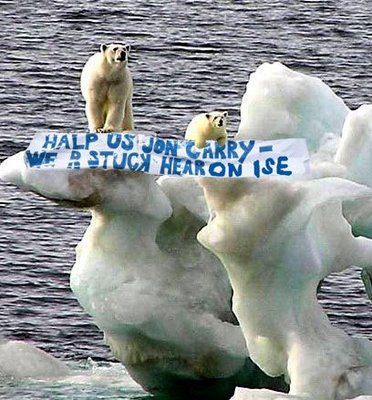
The slightly tongue-in-cheek term “The Gore Effect” — meaning an abrupt change of local weather towards intense cold when or after Al Gore (prophet of Anthropogenic Global Warming) visits that location — became so-named after a few incidents several years ago (see the link above). These days, it’s generally applied whenever any Warmist group holds an event and is suddenly faced with unseasonably cold weather (e.g., the Global Warming Cruise aboard an icebreaker that subsequently got stuck in sea ice).
Now Steve McIntyre, famed debunker of the Mann Hockey Stick graph, points out that his own home town of Toronto, Canada, has experienced the Gore Effect first-hand. Here’s a graph of annual snowfall in Toronto:
As you can see, Al Gore visited Toronto in 2007 — three times, as it turned out. Now, 2008 has produced more snowfall in Toronto than any year in the past 120 years. Be sure to read Steve’s whole article for details (and photos!). ..bruce w..
Some seasonal cheer for you
Courtesy of The Daily Bayonet, who got it from Jammie Wearing Fool:
Heh.
UPDATE: And here, courtesy of Dave Barry, is striking scientific proof that white people — particularly Southern white people — are inherently rhythmically challenged:
..bruce w..
Global warming update
Accuweather delivers the bad news:
In the AccuWeather.com Winter Forecast released in early October, Chief Long-range Forecaster Joe Bastardi said the overall colder and snowier winter will be off to a cold start in December, which could be the roughest winter month for much of the nation.
Calling the winter of 2008-2009 one of the harshest in many years, Bastardi said, “It may be a shock to some when compared with the above-average temperatures of last year in the East. It will put some ‘brrrrrr’ in the saddle of folks who have not had to deal with such things for a while.”
Personally, I blame Bush. ..bruce w..
The vast and widespread consequences of global warming
It makes you wonder how earth (and humanity) ever survived the Medieval Warm Period or the Holocene Maximum:
Hat tip to Instapundit. ..bruce w..
Artic Sea Ice On The Rebound

Over the summer the news was that troops of environmental activists were parading through the northwest passage to draw attention to the fact that it was ice free. This was supposed to imply that that run away, man made global warming was wrecking the arctic.
In reality most of these expeditions ended locked in the ice and withdrawing in failure, though you would not know it via the press releases.
In fact, the reduction in sea ice in the arctic was more likely caused by an unusual wind pattern during the early parts of 2008 that shoved the floating ice pack around, opening up some gaps that the global warming pharisees mistook for a sign.
Thanks to a number of factors, including reduced solar output, the northern hemisphere is stepping up for a good old fashioned cold winter. To kick things off, the sea ice in the arctic is growing rapidy. From wattsupwiththat.com:
Arctic sea ice now 28.7% higher than this date last year - still climbing
10/14/2008 7,064,219 square kilometers
10/14/2007 5,487,656 square kilometersA difference of: 1,576,563 square kilometers, now in fairness, 2008 was a leap year, so to avoid that criticism, the value of 6,857,188 square kilometers can be used which is the 10/13/08 value, for a difference of 1,369,532 sq km. Still not too shabby at 24.9 %. The one day gain between 10/13/08 and 10/14/08 of 3.8% is also quite impressive.
Meanwhile, the anemic sun decided to finally toss up a small sunspot cluster, labeled 1005 of the new cycle 24. This might be a signal that our local star is coming off vacation and might start putting out the energy we need to keep warm.
The sea is not the only place where the quiet sun is having an impact. From the Alaska Daily News, Bad weather was good for Alaska glaciers:
Two hundred years of glacial shrinkage in Alaska, and then came the winter and summer of 2007-2008. Unusually large amounts of winter snow were followed by unusually chill temperatures in June, July and August.
“In mid-June, I was surprised to see snow still at sea level in Prince William Sound,” said U.S. Geological Survey glaciologist Bruce Molnia. “On the Juneau Icefield, there was still 20 feet of new snow on the surface of the Taku Glacier in late July. At Bering Glacier, a landslide I am studying, located at about 1,500 feet elevation, did not become snow free until early August. “In general, the weather this summer was the worst I have seen in at least 20 years.”
Never before in the history of a research project dating back to 1946 had the Juneau Icefield witnessed the kind of snow buildup that came this year. It was similar on a lot of other glaciers too.
So while the current theme is that the earth is warming up, I think the more credible concern might be that we are cooling off. For most of humanity, being a bit warmer is actually welcome, where as the kind of chill that has happened in the past could be very dangerous for crops and food production.

One thing is for sure, this year’s version of “Deadliest Catch” should be a good one to watch. Some of my favorite segments include ice breaking on ships like F/V Northwestern.
Don’t Panic - NASA’s Tuesday Solar Press Conference

Friday the blog world was examining this curious press release from NASA:
NASA To Discuss Conditions On And Surrounding The Sun
WASHINGTON — NASA will hold a media teleconference Tuesday, Sept. 23, at 12:30 p.m. EDT, to discuss data from the joint NASA and European Space Agency Ulysses mission that reveals the sun’s solar wind is at a 50-year low. The sun’s current state could result in changing conditions in the solar system.
Bloggers took this in ran in several directions at once, ranging from NASA getting ready to declare that the next ice age is upon us, the Sun is about to go out and all manner of speculation in between. Now, courtesy of Watt’s Up With That, a bit of perspective.
The press conference Tuesday is instead to discuss this paper: Weaker solar wind from the polar coronal holes and the whole Sun
Abstract
Observations of solar wind from both large polar coronal holes (PCHs) during Ulysses’ third orbit showed that the fast solar wind was slightly slower, significantly less dense, cooler, and had less mass and momentum flux than during the previous solar minimum (first) orbit. In addition, while much more variable, measurements in the slower, in-ecliptic wind match quantitatively with Ulysses and show essentially identical trends. Thus, these combined observations indicate significant, long-term variations in solar wind output from the entire Sun. The significant, long-term trend to lower dynamic pressures means that the heliosphere has been shrinking and the heliopause must be moving inward toward the Voyager spacecraft. In addition, our observations suggest a significant and global reduction in the mass and energy fed in below the sonic point in the corona. The lower supply of mass and energy may result naturally from a reduction of open magnetic flux during this period.Received 11 June 2008; accepted 14 August 2008; published 18 September 2008.

What does this mean? The spacecraft Ulysses, which recently ended its mission, gathered a great deal of data about our Sun during its years orbiting pole to pole. Part of what it saw on its last orbit was a marked decrease in solar output. This is consistent with the “quiet sun” period we have been seeing the last several months.
Does this mean we should all run out and buy “Snow Machines”? It does mean that as long as these conditions hold, the Sun is pumping less heat and energy into Earth’s atmosphere. However keep in mind that our world’s oceans are an enormous heat sink, and any changes to input energy will only slowly make a difference in temperature over time.
The net outcome is the Ulysses project was a huge scientific win, and NASA would do well to consider a follow on mission in the same vein. If the trend continues, we have a fantastic opportunity to study our sun during a period of quiet unlike what we have had the opportunity to study in the modern age.
[Update] The awesome solar site solarcycle24.com shows a new “sunspeck” in today’s update. One of the tiny tiny little dots that have been the best that cycle 24 could muster thus far have shown up in the past hours. Sadly it’s too late for me to image it directly from the back porch…
Just in case you were wondering…
…the sun is blank — no sunspots:

This is how the sun has been for the last six weeks or so. ..bruce w..
Real Scientists Speak Up On… Global Cooling?

Get your snowboards waxed… the next ice age may be here soon!
I have been talking about how quiet sunspot cycle 24 has been, and how it’s possible that may foretell a cooler period in the Earth’s climate for the next set of years. I have also pointed out that I am a computer engineer, and come by these ideas based on personal study and application of new software techniques to assemble trends from huge quantities of information. That means take what I say with a grain of salt.
Now we get word from the excellent Watts Up With That site, stating that some of the real atmospheric scientists are starting to discuss the possibility of a much cooler world in a few years:
Four scientists, four scenarios, four more or less similar conclusions without actually saying it outright — the global warming trend is done, and a cooling trend is about to kick in. The implication: Future energy price response is likely to be significant.
Late last month, some leading climatologists and meteorologists met in New York at the Energy Business Watch Climate and Hurricane Forum. The theme of the forum strongly suggested that a period of global cooling is about emerge, though possible concerns for a political backlash kept it from being spelled out.
Words like “highly possible,” “likely” or “reasonably convincing” about what may soon occur were used frequently. Then there were other words like “mass pattern shift” and “wholesale change in anomalies” and “changes in global circulation.”
Noted presenters, such as William Gray, Harry van Loon, Rol Madden and Dave Melita, signaled in the strongest terms that huge climate changes are afoot. Each weather guru, from a different angle, suggested that global warming is part of a cycle that is nearing an end. All agreed the earth is in a warm cycle right now, and has been for a while, but that is about to change significantly.
The take away is that there are multiple atmospheric and solar factors pointing towards cooler temperatures for some period of time starting around the end of the decade. This could spell some serious trouble for scientists and weather networks who have staked their reputation on human boosted global warming.
In addition this interesting tidbit I stumbled across earlier today.. (Hey, I gave blood - I am allowed to be a bit stumbly!)

This is from NASA and is a long range forecast for sunspot cycle 25. Now these same goofs have been completely wrong on cycle 24 (the current cycle) with it clocking in well below their predictions. These graphs keep getting revised to push the cycle 24 bulge further right as the sun stays surprisingly quiet.
But if there is any accuracy in this, we could be looking at a marked decrease in solar energy reaching the earth for the next decade or two. For those of you wondering, that solar energy is the primary force that drives everything on earth, and is the only real mechanism to warm and heat the planet.
This will be interesting to monitor, but if you love snow sports (like I do) we may be headed into a golden age.
How many times have you read this?
An ineffectual international organisation yesterday issued a stark warning about a situation it has absolutely no power to change, the latest in a series of self-serving interventions by toothless intergovernmental bodies.
“We are seriously concerned about this most serious outbreak of seriousness,” said the head of the institution, either a former minister from a developing country or a mid-level European or American bureaucrat. “This is a wake-up call to the world. They must take on board the vital message that my organisation exists.”
The director of the body, based in one of New York, Washington or an agreeable Western European city, was speaking at its annual conference, at which ministers from around the world gather to wring their hands impotently about the most fashionable issue of the day. The organisation has sought to justify its almost completely fruitless existence by joining its many fellow talking-shops in highlighting whatever crisis has recently gained most coverage in the global media.
“Governments around the world must come together to combat whatever this year’s worrying situation has turned out to be,” the director said. “It is not yet time to panic, but if it goes on much further without my institution gaining some credit for sounding off on the issue, we will be justified in labelling it a crisis.”
Heh. Hat tip to Daniel Drezner. ..bruce w..
Sunspot Update - Our Quiet Sun

Our sun, the largest single input of energy to our world, continues its quiet period. For the past 16 days there has not been any sunspots on the face of our local star. If you discount the small spots visible only because of our modern powerful tools, the blank period is much longer than that.
As we noted earlier, the original estimates for solar cycle 24, which should have started months ago, was for it to be a nasty high-output affair. An active sunspot cycle that would boost the output of the sun, bathing the earth in excess light and heat, keeping the temperatures on the incline.
What this implies is anyone’s guess. But there are several theories about the last time the sun took a rest that coincided with significant cooling events, including a period known as the “Little Ice Age“.
The last period of minimum sunspot activity was in 1997. As you can see from the chart below (based on data from the excellent site solarcycle24.com), the current minimum started out in June 2007 in the normal range, but over the past few months have dropped off to a very quiet state.

If this continues, we will have a fantastic opportunity to study what happens when the sun goes quiet, and it will greatly enhance our understanding of how stars work. On the other hand, if it’s connected to periods like the little ice age, we may soon be looking for ways to emit as much CO2 as we can.