
Thought for the day
An elephant hunter usually gets killed by an elephant. — Swahili proverb From Contemplate, one of my daily blogs (this link gives you a random proverb each time you read it). ..bruce w..
An elephant hunter usually gets killed by an elephant. — Swahili proverb From Contemplate, one of my daily blogs (this link gives you a random proverb each time you read it). ..bruce w..
Gerard Van der Lune — one of the best writers in the Blogosphere — does a Saturday stroll through Seattle’s University District: Saturday was an especially good day for seeing the University District as it really is. It was Street-Fair Saturday and, as I remarked to my friend after strolling a couple of blocks, the […]
One of the books I’m currently writing is Pitfalls of Modern Software Engineering, a greatly expanded and updated version of a book I published back in the 1990s. I’ve been posted new and revised pitfalls over at my Bruce F. Webster & Associates (bfwa.com) website. To make the pitfalls a bit easier to browse, I’ve […]
OK, I wrote an initial review after watching Part 1 of A&E’s miniseries, “The Andromeda Strain”. It was goofy and heavy-handed in its political agenda, but was still a bit fun, and I was waiting to see how Part 2 went. So now I’ve watched Part 2, which (IMHO) descended from goofiness into full-blown stupidity. […]

Some folks may have noticed that we have yet to update our trend animator with banking data for the first quarter of 2008. It’s not because we don’t want to, it’s because the FDIC has yet to release their data. Yes, that’s right – one of the more interesting quarters of the US banking industry […]
You expect two major newspapers — say, the Washington Post and the New York Times — to cover the same major news stories, each with its own particular slant. What you don’t expect is for these two news papers to run, on exactly the same day (today), feature articles over virtually the same subject, particularly […]
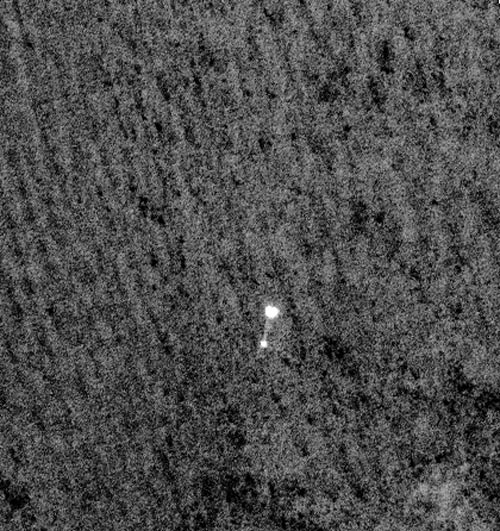
Over the long US holiday weekend, the latest Mars probe known as “Phoenix” landed near the Martian north pole. As wonderful as it is when we can actually get some of our gear on Mars to work correctly, it was even more fun that we were able to snap a picture of it taking place. […]
Jeffrey Denning is a former TSA air marshal who has been serving in Iraq with the US Army Reserve. He just returned home only to face immediately a TSA investigation into an e-mail he received and forward asking “current and former air marshals to talk to CNN”: My wife and I had an interesting conversation […]
OK, Sandra and I just finished watching the first two hours of A&E’s mini-series, “The Andromeda Strain”, based on the Michael Crichton novel. Sandra, about 45 minutes into tonight’s showing, turned to me and said, “This is like a SciFi Channel movie, but made with better actors.” What makes that really funny is that she […]

Liveblogging the DNC Rules & Bylaws Cmte meeting
[break for lunch — them, not me — will reconvene at 4:15 EDT, 2:15 MDT] Wow. This has been great fun, and the discussion and debate for the most part has been pointed, intelligent, and sharp (with exception to the occasional lame references to the Florida 2000 election). I’m going to be gone for a […]
Read More