Archive for March, 2007

27 Mar

Interesting comparison of utility bills

Today’s Washington Post has an article about the resignation of Lawrence Small from his post as Secretary of the Smithsonian Institution. The following paragraph (on page 2 of the story) caught my eye:

Small has also received $1.15 million in housing allowances over a six-year period in return for agreeing to use his 6,500-square-foot home in Woodley Park for Smithsonian functions. To justify those expenses, Small submitted receipts for $152,000 in utility bills, $273,000 in housekeeping services and $203,000 in maintenance charges, including $2,535 to clean a chandelier. The home-repair invoices show $12,000 for upkeep and service on his backyard swimming pool, including $4,000 to replace the lap pool’s heater and water pump.

Now, $152,000 in utility bills over a six-year period works out to at least $2,100/month (that presumes the sum covers a full 72 months). Hey! That’s almost as much as Al Gore! And for a smaller house (6,500 sq ft vs. 10,000 sq ft), to boot!

For the record, we live in a 6,000-square-foot house here in Parker, Colorado. This house has a lot of windows and sits on a ridge, where we have frequent winds (the wind is howling outside even as I type this). It gets a lot colder here than it does in DC; I know because we lived in northwest DC (Friendship Heights and Cleveland Park, the latter just a few blocks north of Woodley Park, where Small lives) for six years before moving here to Colorado in 2005. And we’re about 6200 feet above sea level, roughly 20 miles southeast of downtown Denver. To wit:

This sums up December through Februrary

I work primarily out of our home, and between myself, my wife Sandra, and our daughter Salem, we own and use nine (9) computers, at least a few of which are on at any given time, along with a router, several wireless access points, a few gigabit network switches, at least three printers, and a couple of network/external hard drives. (Total hard disk storage when everything is powered up is something over two [2] terabytes.) We have three TVs, each with its own satellite box and separate Panasonic DVR. With the exception of our water heater/house heating system (integrated, runs off propane), all of our appliances are electric: fridge, small chest freezer, dishwasher, oven, stove, microwave, washer and dryer. Heck, even our water is electric — we run off of a well.

And yet our electric bill runs between $200 - $270/month.

Propane costs have run from a peak of around $500/month during the Great Denver Blizzard to about a fourth of that during the summer months. And I spend about $500/year on firewood (we have a wood-burning stove in our living room). So that means our utilities vary through the year from $350 to $800 a month. I may go back and analyze the actual bills, but my guess is that the average works out to roughly $500/month, or about 25% of Small’s monthly utility bill for a house of roughly the same size.

Now I will say this in Small’s defense (for the utility bills, not for his expensing them to the Smithsonian): he lives in Washington DC. This means that his air conditioning is likely running 24/7 for at least two months (July and August) and is on a good deal of the time in May, June, and September. But that’s only a couple of months each year — I’m still trying to figure out how he averages $2,100/month in total utilities. ..bruce..

24 Mar

Tweeter Cuts Back - Video Fans Mourn

Tweeter Cuts Back - Video Fans Mourn

Tweeter is a good store, they have an excellent selection of equipment, the sales staff tend to have a clue (at least at the local ones) and the prices are competitive. I purchased my current, highly prized Samsung DLP at Tweeter, and I was very happy with the sales and support.

Now word comes (via Consumerist) that Tweeter is closing 49 of their stores. Of special note (and grim news to me) is that they are calling it quits in places like California and New York.

“As we continue to face the challenges of our ever-changing industry, we do so with a renewed focus on the future of our brand and on our ability to deliver the ultimate consumer electronics shopping experience,” said Tweeter President and CEO Joe McGuire. “We have therefore made some critical decisions to both consolidate and reinvest our resources.”

While there are some on Wall Street and in the press who insist the economy is not in rough water at the moment, this should be a pretty clear signal that revenues are not meeting operating needs. This on the heels of CompUSA pulling out of more than 50% of their locations.

What is a video nerd to do?

Tweeter Press Release

23 Mar

Nation Wide Real Estate Inventory Rocketing Higher

Last year marked the start of the housing downturn in several markets. The clearest indicator was the ballooning levels of existing home inventory for sale, and the fact that these homes largely stayed on the market until Thanksgiving without moving in an appreciable way. In some markets, at the sales flow rate at the time, there was upwards of a 10 month supply of inventory in the market looking for a buyer.

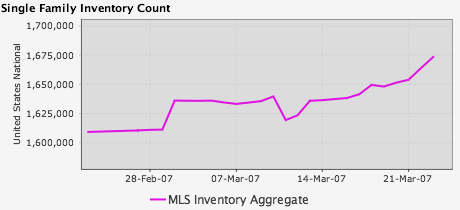
For those of us watching the real estate market, all eyes were on the MLS inventory leading into the spring selling season. Currently the inventory levels nation wide stand at:

Single Family: 1,673,425 (+64,191)
Multi Family: 107,960 (+4,546)
Condo: 475,781 (+28,981)
Land: 481,599 (+9,983)

March 21st Single Family Inventory Graph

The numbers in the parentheses are the amount of inventory added in the last month. It is normal for more homes to come on the market at the start of spring (on this day alone, nearly 13,000 single family homes were added), the question is will the sellers show up to buy.

Pro-Buying Factors

  • There is a lot of inventory to choose from
  • Prices have come down from their highs in 2005


  • Anti-Buying Factors

  • Prices are still ridiculously high
  • Prices are likely to drop more over the next few years (and buyers know it)
  • Funding is tougher to get unless you have good credit and 10% - 20% to put down


  • We will be watching this as it unfolds, as always you can watch the markets on Hardtack

    20 Mar

    Support for a science blog

    Tetrapod Zoology has become one of my favorite blogs. It’s written by Darren Naish, who describes himself thusly:

    Darren Naish - me - is, or was, a vertebrate palaeontologist, formerly based at the University of Portsmouth, UK. They still host my homepage, but have usefully deleted all the links to the pdfs I so lovingly uploaded (if you want pdfs of any of the papers listed there don’t hesitate to email me and ask: eotyrannus at gmail dot com). From 1997 to 2006 I worked on the predatory dinosaurs of the Lower Cretaceous of southern England, focusing for my phd on the basal tyrannosauroid Eotyrannus. A full monographic description of Eotyrannus will be published one day. Since completing the phd I’ve been trying to find a job in academia, but so far all applications have been unsuccessful. That’s pretty depressing; my future is uncertain.

    I like dinosaurs very much, but they’re far from the only animals that I find interesting. I’m fascinated by all tetrapods and have some practical and research experience with Mesozoic marine reptiles, marine mammals, flightless birds and pterosaurs. I spend as much time in the field as possible, looking at real live tetrapods. I’m married and have a 5-year-old son.

    Naish writes entertainingly on various issues in both paleontology (dinosaurs!) and modern zoology (vampire bats!), with occasional mixing of the two (giant extinct vampire bats!) and other side-trips (Godzilla!). He also utterly refuses to dumb down his work, and many of his postings contains long lists of academic citations.

    Like many other bloggers, he’s made a quiet request for donations to keep his blog running. Consider helping Darren out; I have already.  (Note: the ‘Make a Donation’ button is near the bottom of the left-hand column on his blog site.)  ..bruce..

    19 Mar

    In God We Trust - All Others Bring Data

    It should come as no surprise that divining and quantifying what is happening to the housing market and the connected financial systems is a topic of significant interest for me. While there is an excellent and growing suite of web sites and Blogs around that document elements of what is happening, one piece of information had been elusive - until today.

    Mr. Webster is very gracious with his description of who I am and what I do. For the last couple of years myself and a small team of folks have been working to bring a new kind of software to market. In part it came from efforts inside the Intelligence Community to build tools to find bad people faster. This is usually an exercise in “connect the dots”, piecing together high value information out of disparate and possibly unrelated chunks of data. We have been selling this tool kit under the name Boomerang for the last year or so, with some success.

    One major component to the economy over the last few years has been housing, and housing’s rapid appreciation. There is a strong suspicion that any downturn will have a large housing component as well — specifically that people will finally get to a point where they are asking so much for properties that no one can reasonably afford to buy. To see if that is happening, one has to be able to look across all of the separate multiple listing services (MLSs) and piece together a fused, national / region / state / market picture. Sounds like a job for Boomerang!

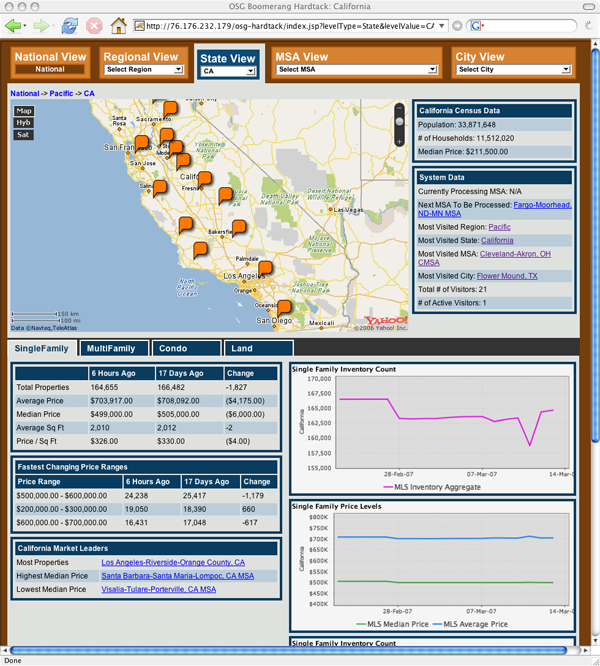
    So here is our application: Hardtack National View

    Hardtack Screen Shot

    We call it (for the moment) Hardtack. Why? Well, there was a series of weapons tests in the Pacific back in the 50’s where they were trying to get the design for a new type of bomb working. This includes some explosions that were significantly larger than planned, leading to very dangerous and in some cases deadly fallout. This series of tests were called “Operation Hardtack”. Hence the name, as I worry the explosion in housing will lead to some rather unfortunate fallout.

    How to use it:

    First off, you will see the map and the pull downs across the top. Each one of the orange icons will let you “drill in” to a region or more narrow data set. Likewise you can use the pull downs to select a region, state or major city (MSA). Below you will see a set of statistics for different real estate products, as well as charts that show the progress of these key statistics over time.

    Feel free to take a look around over there - coming soon will be RSS feeds that will ease the ability to subscribe to your favorite region, and Hardtack will tell you what is happening week to week in that market.